
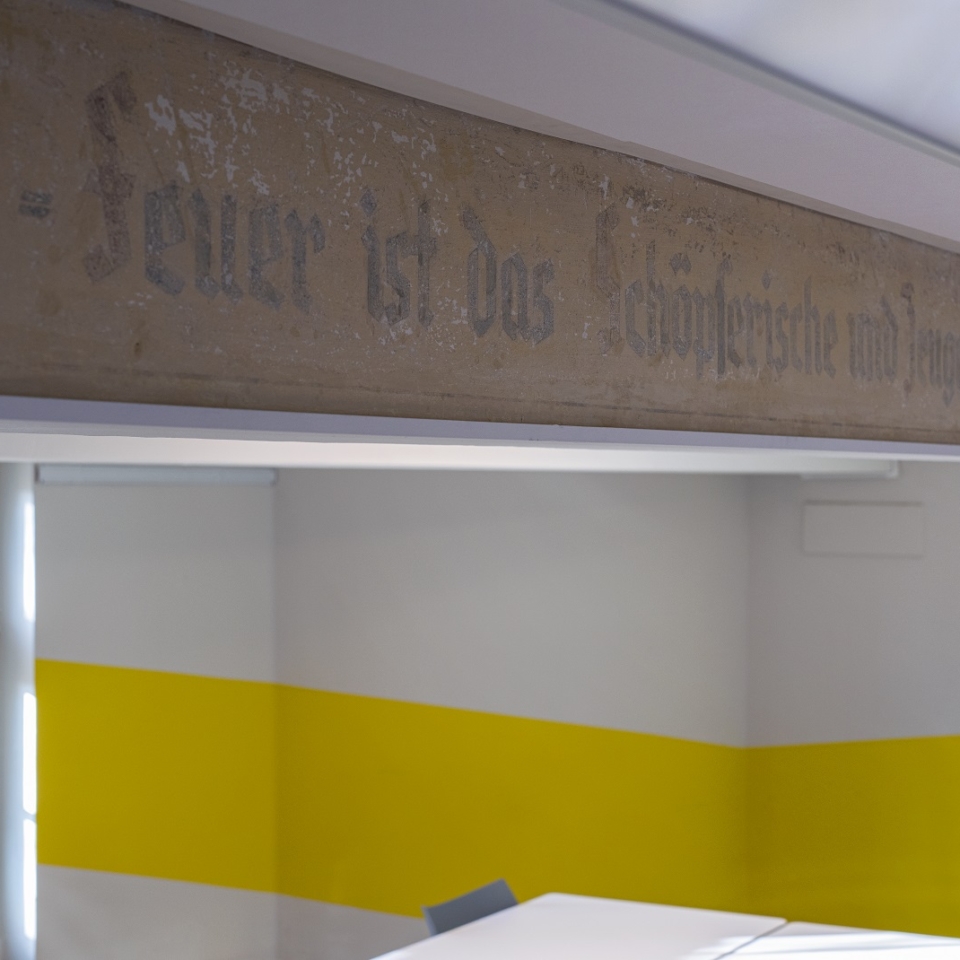
In the former map room of the library, which is now used as a classroom, you will find German writing in Gothic lettering on the side of a supporting roof beam. It reads:
‘Recht, Ordnung, Sitte und Tucht sind Lebensgrund deutschens Wesens. Feuer ist das Schöpferische und teugende, des ewige Wandel’.
(‘Law, order, customs and behaviour are the basis of life for Germany. Fire is the creative and virtuous aspect of eternal change.’)
Known as ‘The German text’ within the institute, the writing came to light in the map room during renovation work. It represents the sole visible remnant from the World War II era within the building. Other traces from that period — painted eagles, beer steins, and swastikas carved into the walls — have since been painted over or removed.
During the Second World War (1940–1945), the Netherlands was occupied by the Germans. Germany was ruled by a totalitarian dictatorship under Adolf Hitler and his National Socialist German Workers’ Party (NSDAP). His followers (“Nazis”) sought to incorporate the Netherlands into their “Greater Germanic Reich” and reshape society according to Nazi rules. The text, with its Gothic letters, reflects the ideology that prevailed from the 1930s onwards: the German (Aryan) “race” was deemed superior to other non-Aryan races and had to be protected from foreign influences. This extremely nationalistic worldview led to the invasion and occupation of large parts of Europe, as well as antisemitism, which culminated in the systematic persecution and mass murder of six million Jewish people in the Holocaust. Political opponents, Jehovah’s Witnesses, people with physical disabilities, homosexuals, Slavs, and Romani and Sinti people were also considered ‘inferior’ and persecuted and murdered on a large scale.
After the invasion, daily life in the Netherlands dramatically changed: there were shortages of food and goods, freedom of expression was suppressed, and many people lived in fear. At the same time, there was resistance: strikes, the printing of illegal newspapers, and the hiding of people in danger. The Jewish population was persecuted and gravely affected: more than 100,000 Jews from the Netherlands were deported and murdered in concentration camps. In the final winter of the war, known as the Hunger Winter (1944–1945), thousands of Dutch people died from food shortages. Liberation came in May 1945, brought by Allied troops from Great Britain, Canada, the United States, and Poland.
The German text is a remnant from the period when a large part of the building of the Colonial Institute was taken over and used by the German police force. On 15 May 1940, German troops entered the city of Amsterdam. At first, the occupiers claimed that everything would remain the same, but soon municipal services were drawn in to collaborate with oppression and persecution. The Colonial Institute was forced to accommodate the Ordnungspolizei (Order Police), also called the Grüne Polizei (Green Police) because of their green uniforms. The battalions largely took over the building: the sections at Mauritskade 63, including the main entrance and the Marble Hall, were turned into (service) offices, medical and dental practice rooms, and storage areas. The richly decorated rooms of the General Secretariat, the Council Chamber, the Board Room, and the President’s Room had to be vacated. Parts of the Institute library suddenly had to relocate and were placed under the Ethnology Department. Valuable pieces from the museum collection had already been put into storage. The Auditorium (now the Maxima Hall) was used for political gatherings and screenings. By the end of 1940, the new headquarters also served as a barracks, a prison, and later even a courtroom.
In their role, the Ordnungspolizei carried out ordinary police tasks such as traffic regulation and law enforcement, but this escalated during the war into repression and persecution. Despite the occupation, the Colonial Institute continued limited activities in the early war years, such as organising exhibitions and film screenings, until it ceased all work in 1944.
Despite the presence of the German battalions, the institute also harboured so-called illegal activities: radios were hidden in the building, anti-German pamphlets were printed and distributed, and a few people found temporary shelter or a workspace there. In the first year after liberation, the institute continued to serve as a barracks — this time housing Canadian troops. Later, in 1964, the Board of Directors approved a large-scale renovation plan to repair the damage inflicted on the building.
Sources:
- Frank, D. Cultuur onder vuur: Het Tropeninstituut in oorlogstijd. KIT Publishers, 2012.
- Woudsma, J. An Amsterdam Landmark. KIT Royal Tropical Institute, Amsterdam. 2018.
- www.noid.nl
- www.annefrankstichting.nl
.